
Understanding the Horizon: What is a Knot and a Nautical Mile?
Introduction: The Language of the Infinite Blue
Imagine you are standing on the flybridge of a sleek, 2026-model Lagoon catamaran, the Turkish coastline blurring into a haze of turquoise and pine behind you. You ask the captain how far it is to the hidden coves of Göcek, and he responds with "12 nautical miles," adding that you are currently making "8 knots." To the uninitiated, these terms might sound like an archaic secret society's code. To the mariner, they are the fundamental units of survival, navigation, and tradition.
In our high-tech era of 2026, where satellite navigation and AI-driven chartplotters can pinpoint your location within centimeters, the logic behind the "Knot" and the "Nautical Mile" remains as relevant as ever. These aren't just arbitrary numbers; they are deeply rooted in the physical curvature of our planet and the history of human exploration. Understanding these units is the first step in transitioning from a guest to a true citizen of the sea. Whether you are a software architect looking for technical precision or a dreamer seeking the freedom of the horizon, let’s decode the mathematics of the ocean.
1. What is a Nautical Mile? (The Geometry of the Earth)
On land, we use the "Statute Mile" (5,280 feet), a unit originally based on a thousand Roman paces. But the sea is vast and follows the curve of the Earth. Sailors needed a unit that worked in harmony with the globe.
- The Latitude Connection: One Nautical Mile (NM) is equal to exactly one minute of latitude.
- The Math: Since there are 60 minutes in a degree, and 360 degrees in a circle, a nautical mile is a slice of the Earth’s circumference.
- The Physical Distance: Internationally standardized, one nautical mile is exactly 1,852 meters (approx. 6,076 feet). This makes it roughly 1.15 times longer than a standard land mile.
- Why It Matters in 2026: Because nautical miles are tied to latitude, you can measure distance directly on a paper chart using a pair of dividers against the side scale. Even in 2026, this remains the ultimate "fail-safe" for navigators if the GPS fails.
2. What is a Knot? (Speed Without the "MPH")
If the nautical mile is the "how far," the Knot (kt) is the "how fast." Crucially, you never say "knots per hour"—that would be like saying "miles per hour per hour." A knot is a standalone unit of speed.
- The Definition: 1 Knot = 1 Nautical Mile per hour.
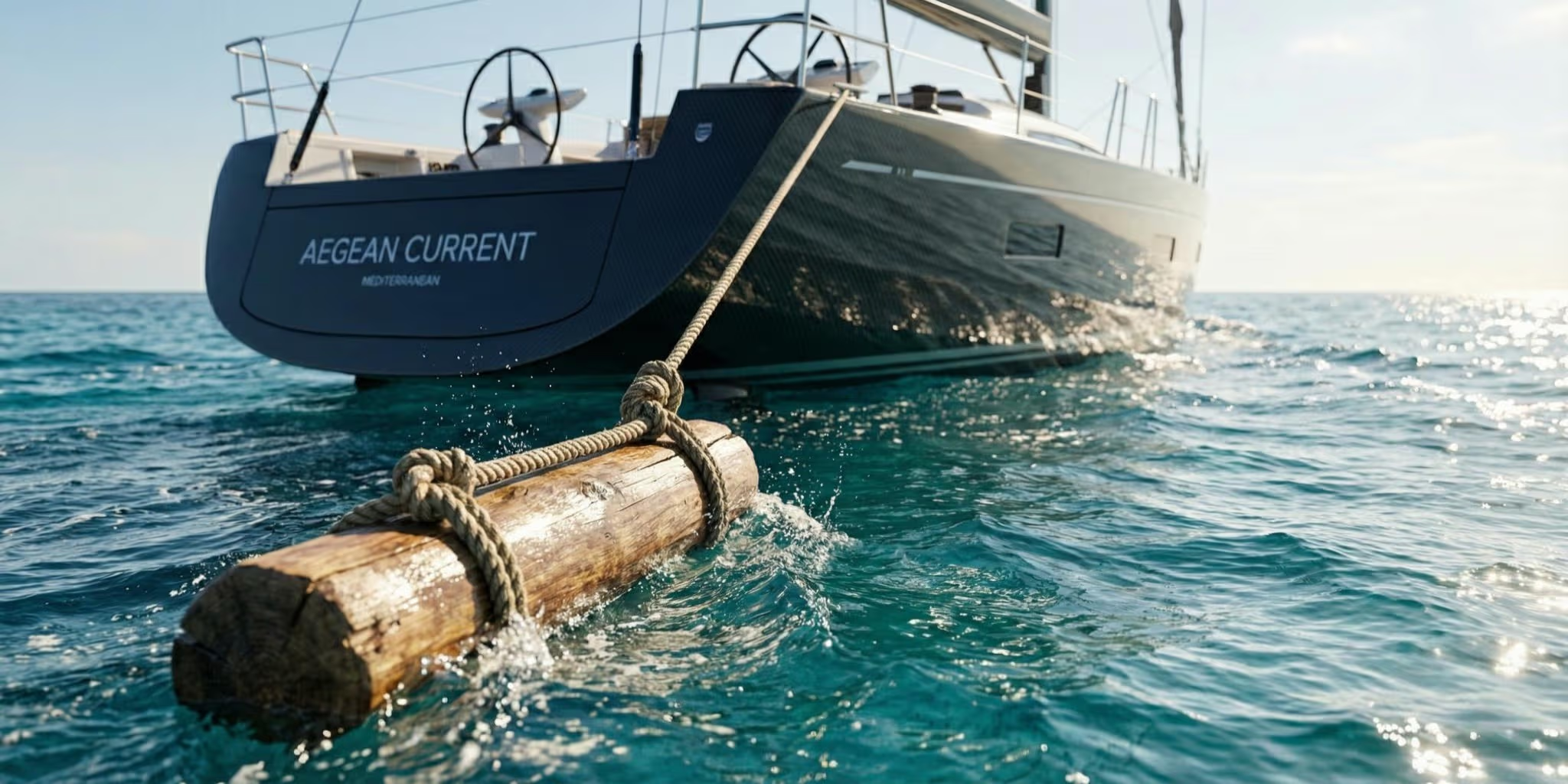
- The History of the Log: In the 17th century, sailors would throw a wooden board (a "log") attached to a knotted rope into the water. They would count how many knots passed through their fingers in a specific amount of time (measured by an hourglass).
- 2026 Context: Modern yachts use ultrasonic or electromagnetic sensors to measure speed through the water, but we still call the resulting data "knots" in honor of those brave enough to count rope in a storm.
3. Comparison: Maritime vs. Land Units
To visualize the difference during your 2026 voyage, use this quick reference table:
| Unit | Nautical (Sea) | Statute (Land) | Conversion Factor |
| Distance | 1 Nautical Mile | 1 Statute Mile | $1 \text{ NM} = 1.15 \text{ Mi}$ |
| Speed | 1 Knot | 1 MPH | $1 \text{ Knot} = 1.15 \text{ MPH}$ |
| Measurement | 1,852 Meters | 1,609 Meters | $1 \text{ NM} \approx 1.85 \text{ km}$ |
| Basis | Earth's Circumference | Roman Paces | N/A |
4. Speed Through Water vs. Speed Over Ground
In 2026, your chartplotter will often show two different speeds. Understanding the difference is vital for safety and fuel efficiency.
- Speed Through Water (STW): This is how fast your hull is moving relative to the water around it. If you are doing 10 knots STW but heading into a 3-knot current, your progress is slowed.
- Speed Over Ground (SOG): This is your actual progress relative to a fixed point on Earth, calculated by GPS.
- The Real-World Example: If your yacht is making 8 knots STW, but you have a 2-knot current pushing you from behind, your 2026 GPS will show an SOG of 10 knots. You are "making good" more distance than your engine is working for!
5. The Beginner’s Navigation Checklist for 2026
Before you set sail on your next 2026 charter, keep these expert tips in mind:
- [ ] Practice the 1.15 Rule: If you’re used to driving a car, remember that 20 knots is actually about 23 mph. It feels faster on the water!
- [ ] Respect the "1 Minute" Rule: Remember that 1 minute of latitude on your chart is 1 nautical mile. This makes manual plotting incredibly intuitive.
- [ ] Monitor Your SOG: Always check your Speed Over Ground against your Speed Through Water to understand how the currents are affecting your arrival time.
- [ ] Forget "MPH": To sound like a true mariner and communicate effectively with coastguards or other vessels, strictly use "Knots" for speed and "Nautical Miles" for distance.
Conclusion: Mastering the Blue
Navigating the ocean in 2026 is a blend of ancient wisdom and futuristic technology. By mastering the concepts of the knot and the nautical mile, you aren't just learning units of measure; you are adopting the perspective of the world’s greatest explorers. You are beginning to speak the language of the sea, a language that values the relationship between the vessel, the water, and the very shape of the Earth.
Are you ready to test your 2026 navigation skills on the open water? Whether you want to calculate your "speed made good" on a luxury monohull or simply enjoy the breeze at 15 knots on a power catamaran, we have the perfect fleet for your next adventure.
[Explore Our 2026 Charter Fleet and Book Your Voyage Today]
FAQ Section
Q: Why don't we just use kilometers and km/h at sea?
A: Because nautical miles are directly linked to the degrees and minutes of latitude on a map. Navigators can calculate their position and distance using simple geometry on a globe, which remains more reliable than the metric system when traveling across the Earth's curved surface.
Q: How fast is a "fast" yacht in 2026?
A: For a cruising sailboat, 8 to 10 knots is considered a very respectable speed. High-performance foiling yachts can exceed 30 knots, while luxury motor yachts typically cruise comfortably at 18 to 25 knots.
Q: Is a nautical mile the same everywhere on Earth?
A: Since the Earth is not a perfect sphere (it’s an oblate spheroid), the physical length of a "minute of latitude" varies slightly from the equator to the poles. However, the international standard was set at exactly 1,852 meters in 1929 to provide a consistent unit for all mariners regardless of their location.
Meta Title:
Meta Description:
Tags:
Category: Beginner Guides
Tags:
Related Articles
Navigating the Currents: The Essential Guide to Boat Insurance and Coverage for 2026
Protect your dream and your pocketbook. Master the complexities of marine insurance and secure the best boat coverage for your 2026 maritime adventures.
Set Sail with Confidence: What to Know Before Attending a Sailing Course in 2026
Transition from passenger to captain. Discover the essential certifications, gear, and mental prep needed for your 2026 sailing course success.
Master the Quay: Marina Rules and Maritime Etiquette for 2026
Don't be "that boat." Master the unspoken laws of the harbor and professional marina etiquette to ensure a seamless and respected 2026 voyage.