

True North: Mastering Compass Use and Maritime Navigation in 2026
Introduction: The Soul of the Navigator
There is a profound moment in every sailor's journey when the digital screens dim and the only thing standing between you and the vast, open horizon is a floating needle in a liquid-filled dome. In an era dominated by high-definition chartplotters and satellite-linked smartwatches, the magnetic compass remains the unshakeable soul of the vessel. It is the one instrument that requires no batteries, no signal, and no complex software updates to tell you the most important truth on the water: which way is home.
For the beginner, a compass can feel like a relic of a bygone age. Yet, in 2026, the best navigators aren't those who rely solely on GPS; they are those who blend high-tech precision with the "black art" of traditional seamanship. Understanding how to read the magnetic field of the Earth—and how to account for the metal of your own boat—is the difference between a stressful passage and a masterful voyage. Whether you are chartering a catamaran in the Seychelles or helming your first monohull, mastering these basics is your rite of passage into the world of true navigation.
1. Anatomy of a Marine Compass: Your Silent Partner
A marine compass is far more sophisticated than the pocket version used for hiking. It is designed to remain stable while the boat pitches and rolls in heavy seas.
- The Compass Card: The rotating disk marked with degrees ($0$ to $360$). In 2026, high-end models feature "dampened" cards that stay steady even on high-speed powerboats.
- The Lubber Line: A fixed vertical line on the compass housing that represents the bow of your boat. Wherever this line points on the card is your current heading.
- The Gimbal System: A pivot mechanism that allows the compass to stay level while the boat heels.
- The Binnacle: The protective housing or stand where the compass is mounted, often equipped with internal lighting for night passages.
2. True North vs. Magnetic North: Mind the Gap
The most common mistake for new navigators is assuming the compass points exactly to the top of the world. It doesn't. This discrepancy is the first hurdle in mastering navigation.
Variation (Declination)
The Earth's geographic North Pole (True North) and its Magnetic North Pole are in two different places. The angle between them is called Variation .
- 2026 Update: Magnetic North is constantly moving. In 2026, the variation in parts of the Mediterranean is approximately $4^{\circ} \text{E}$, while in parts of the Caribbean, it can exceed $15^{\circ} \text{W}$.
- Reading the Chart: Always look at the "Compass Rose" on your nautical chart; it will tell you the local variation and how much it changes annually.
Deviation
Your boat itself is a giant magnet. The engine, the electronics, and even your smartphone can pull the compass needle away from Magnetic North. This error is called Deviation .
- The Deviation Card: Professional boats carry a laminated card showing the error on every heading.
- Expert Tip: Never leave your mobile phone or a set of speakers near the compass. A simple handheld radio can pull a compass off-course by $10^{\circ}$ or more instantly.
3. Basic Navigation Techniques for Beginners
Once you understand the compass, you can begin to use it in tandem with your nautical charts.
Taking a Bearing
A bearing is the direction to a fixed object (like a lighthouse or a mountain peak).
- Align your boat with the object.
- Read the degree on the compass card where the lubber line sits.
- Triangulation: Take bearings of three different landmarks. Where those lines intersect on your paper chart is exactly where you are.
Dead Reckoning (DR)
This is the process of calculating your current position by using a previously determined position (a "fix") and advancing that position based on your known speed and course.
- The Formula: $\text{Distance} = \text{Speed} \times \text{Time}$.
- Why it Matters: If your GPS fails in 2026, your "DR" plot is what keeps you off the rocks.
The Rules of the Road (COLREGs)
Navigation isn't just about where you are; it's about how you interact with others.
- Red Right Return: When entering a harbor from the sea, keep the red buoys on your starboard (right) side.
- Port to Port: When meeting another vessel head-on, both should steer to starboard to pass "port to port" (left side to left side).
4. Navigation Comparison: Traditional vs. Electronic
In 2026, the "Dual Redundancy" principle is the gold standard for safety.
| Feature | Magnetic Compass & Paper Chart | GPS Chartplotter (MFD) |
|---|---|---|
| Power Dependency | Zero | High (12V/24V) |
| Accuracy | High (if calibrated) | Exceptional (within meters) |
| Situational Awareness | Excellent (Big picture) | Limited (Zoom level dependent) |
| Signal Reliability | Absolute | Vulnerable to Jamming/Outages |
| Best For | Redundancy & Direction | Active Routing & AIS |
5. The Beginner Navigator’s 2026 Checklist
Before you slip the lines, ensure your "navigation brain" is engaged with this checklist:
- [ ] Compass Check: Is the lubber line aligned with the boat's centerline?
- [ ] Clean Zone: Are all magnets (phones, tools, speakers) at least 3 feet away from the binnacle?
- [ ] Variation Update: Have you checked the current magnetic variation for your cruising area?
- [ ] Paper Backup: Do you have the physical chart for your destination accessible at the helm?
- [ ] Night Vision: Is your compass light functioning for after-dark arrivals?
Conclusion: Command the Horizon
Navigation is the ultimate expression of maritime independence. While the high-tech sensors of 2026 provide incredible convenience, the true master of the sea is the one who can find their way using the stars, the land, and the magnetic pull of the Earth. By mastering the compass, you aren't just learning an old skill—you are ensuring that no matter what happens to your electronics, you will always be the captain of your own destiny.
Are you ready to test your new navigation skills on the open water? Whether you want a skippered charter to learn the ropes or a bareboat to prove your expertise, our 2026 fleet is equipped with the finest traditional and electronic instruments.
[Explore Our 2026 Fleet & Book Your Navigational Adventure Today]
FAQ Section
Q: Do I need to "swing" my compass every year?
A: Not necessarily. You should check for deviation whenever you install new electronics near the helm or if you notice your compass heading differs significantly from your GPS heading. A professional "compass swinger" is recommended if you plan on doing serious offshore passages in 2026.
Q: What is the "Lubber Line" exactly?
A: Think of the lubber line as the "you are here" marker on your compass. It is a fixed line inside the compass glass that points directly at the bow of the boat. To sail a course of $090^{\circ}$ (East), you turn the boat until the $90$ on the compass card is perfectly aligned with that line.
Q: Can I just use the compass app on my iPhone?
A: For casual use, perhaps, but never for primary maritime navigation . Smartphone compasses are highly susceptible to electromagnetic interference from the boat's systems and are not "dampened" to handle the motion of a vessel in the waves. A dedicated marine compass is a safety requirement for a reason.
Tags:
Related Articles
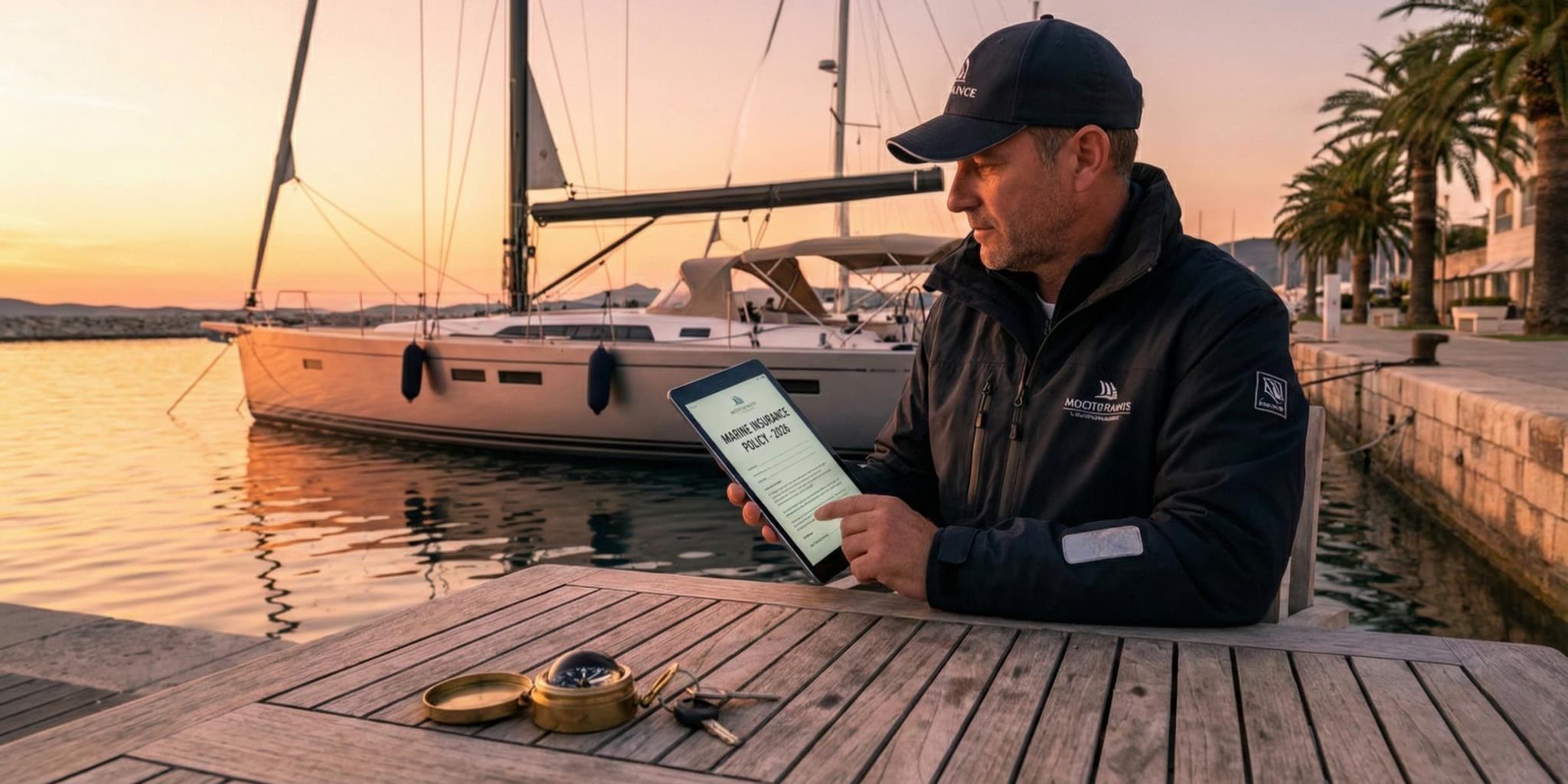
Navigating the Currents: The Essential Guide to Boat Insurance and Coverage for 2026
Protect your dream and your pocketbook. Master the complexities of marine insurance and secure the best boat coverage for your 2026 maritime adventures.

Set Sail with Confidence: What to Know Before Attending a Sailing Course in 2026
Transition from passenger to captain. Discover the essential certifications, gear, and mental prep needed for your 2026 sailing course success.

Master the Quay: Marina Rules and Maritime Etiquette for 2026
Don't be "that boat." Master the unspoken laws of the harbor and professional marina etiquette to ensure a seamless and respected 2026 voyage.