
Master the Dock: How to Tie and Adjust Fenders Correctly in 2026
Introduction: The Unsung Heroes of the Marina
Imagine you are approaching a bustling marina in the Bay of Kotor, the evening sun casting a golden glow over the limestone peaks of Montenegro. Your luxury yacht is pristine, a testament to your hard work and adventurous spirit. But as the wind gusts toward the concrete pier, the dream of a perfect arrival can quickly turn into a nightmare of grinding gelcoat and splintering wood. In this moment, the most important equipment on your vessel isn't your high-tech chartplotter or your carbon-fiber sails—it’s your fenders.
In the maritime world of 2026, where hulls are becoming lighter and more sophisticated, the humble fender remains the primary line of defense between your investment and the world. Tying a fender isn't just about "hanging a buoy"; it is a masterclass in spatial awareness, knot integrity, and maritime etiquette. For the first-time voyager, mastering this skill is a rite of passage. It signals to the harbor master and your fellow mariners that you are a commander who respects both your vessel and the shared space of the sea. Let’s dive into the professional techniques of how to tie and adjust fenders correctly to ensure your 2026 voyages are defined by grace, not repair bills.
1. The Anatomy of Protection: Choosing the Right Fender
Before we touch a line, we must understand the gear. In 2026, the market has evolved beyond simple rubber cylinders to high-performance protection systems.
- Cylindrical (Long) Fenders: The workhorse of the maritime world. Best for standard docks and rafting up against other boats.
- Spherical (Round) Fenders: Essential for protecting the "flare" of the bow or the wide stern of a catamaran. They offer a larger "stand-off" distance.
- Flat Fenders: Growing in popularity for 2026, these are made of high-density foam and don't roll, making them perfect for narrow slips or locks.
- Inflatable Fenders: The choice for space-conscious sailors. These can be deflated and stowed in a locker once you clear the harbor.
2. The Knot of Choice: The Clove Hitch
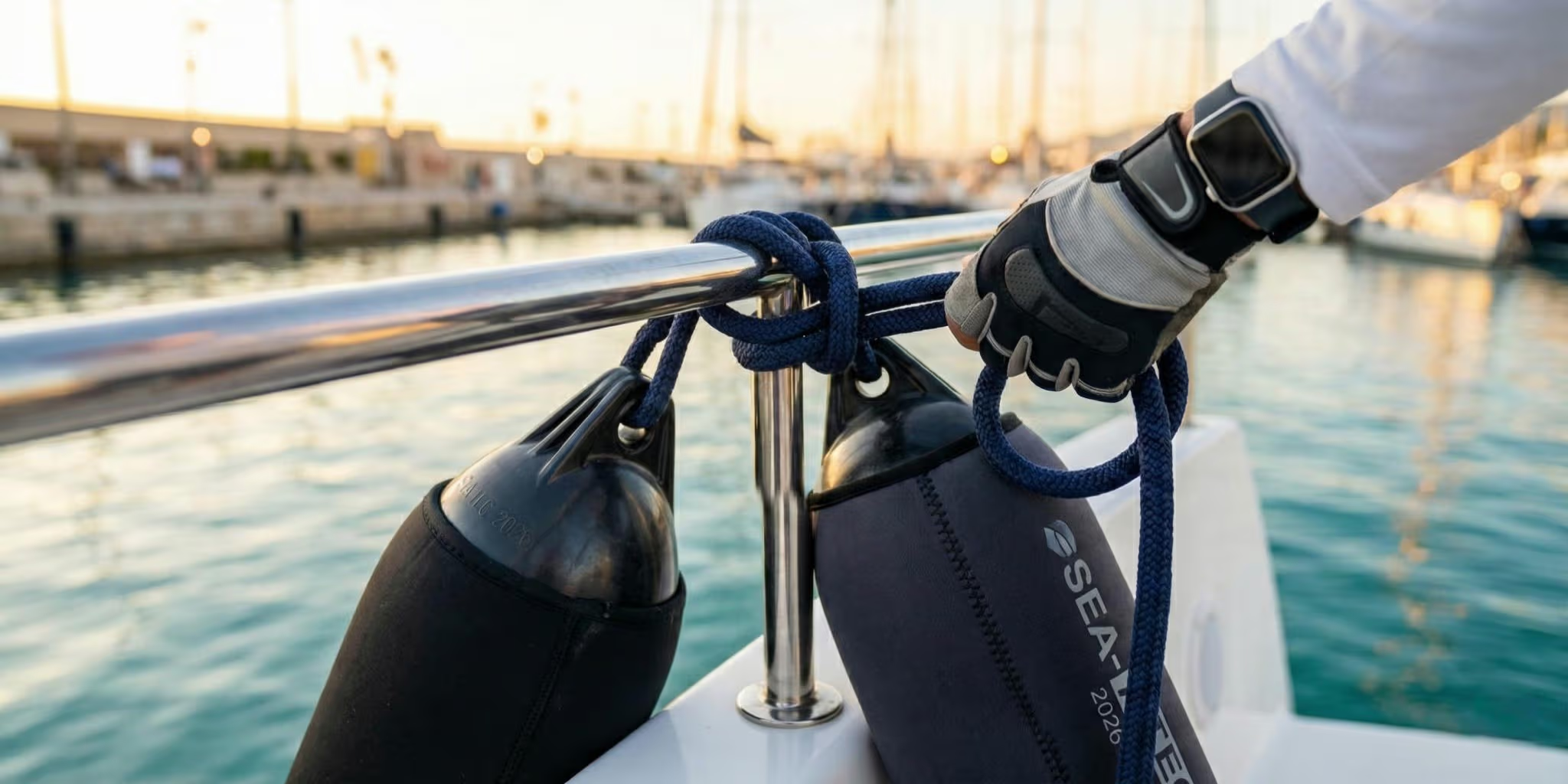
The "Gold Standard" for tying a fender to a lifeline or a handrail is the Clove Hitch. It is simple, secure under tension, and—crucially—easy to adjust.
How to Tie It Like a Pro:
- The First Pass: Wrap the fender line over the rail.
- The Cross: Cross the line over itself to form an "X".
- The Tuck: Pass the line around the rail again and tuck the end under the second wrap (the top of the X).
- The Safety Lock: In 2026, professional skippers always finish a clove hitch with a half-hitch on the standing part. This prevents the line from "working" loose if the boat is rocking in a swell.
3. Height and Placement: The Tactical Setup
The most common beginner mistake is hanging fenders at a uniform height. In 2026, we practice "Contextual Fending."
- Find the "Sweet Spot": The fender should be positioned so that the widest part of its body makes contact with the pier or the neighboring boat.
- The "Gunwale Guard": Generally, the top of the fender should be just below the level of the gunwale or the deck edge.
- Adjusting for Tides: In regions with significant tidal range, you must adjust your fenders as the water level changes. In 2026, many sailors use "fender adjusters" (cleats that slide on the rail) for rapid repositioning.
- Vertical vs. Horizontal: While vertical is the standard, hanging a fender horizontally is the expert move when docking against pilings or "rough" stone quays.
4. Comparison: Traditional vs. 2026 High-Tech Fendering
| Feature | Traditional PVC Fenders | 2026 High-Performance Fenders |
| Material | Standard Vinyl | Multi-layer EVA / Carbon-fiber reinforced |
| Storage | Bulky (Needs fender baskets) | Inflatable / Collapsible |
| Noise | "Squeaky" against the hull | Silent Fleece / Neoprene Covers |
| Durability | Prone to UV degradation | UV-Stabilized / Puncture Resistant |
| Aesthetics | Generic White/Blue | Custom Colors / Brand-matched |
5. The 2026 Fender Etiquette Checklist
Protecting your yacht is only half the battle; maintaining professional etiquette is the other.
- [ ] The "Clean Hull" Rule: Always use fender covers. They prevent the fender's rubber from "scuffing" the gelcoat and eliminate that annoying midnight squeaking sound.
- [ ] Stow Before You Go: Never sail with fenders hanging over the side. It is the hallmark of an amateur (often called "the shame of the sea"). Once the lines are cast, pull them in immediately.
- [ ] Rafting Protocol: When tying up to another boat, the boat arriving usually provides the fenders. However, always have your own ready as a courtesy.
- [ ] Pressure Check: In the 2026 summer heat, air inside a fender expands. Check that they are "firm but yielding." A rock-hard fender will bounce your boat away rather than cushioning it.
- [ ] Line Inspection: Ensure your fender lines are free of salt crystals and chafe. A snapped fender line in a storm can lead to thousands in damages.
6. Expert Tip: The "Fender Board" Maneuver
If you find yourself docking against a pier with exposed, barnacle-encrusted pilings, a fender alone isn't enough—the piling will simply push the fender aside. The 2026 pro move is to use a Fender Board. This is a sturdy plank of wood or composite hung horizontally outside two vertical fenders, creating a flat surface that can slide along the piling safely.
Conclusion: Command with Precision
Learning to tie and adjust fenders correctly is about more than just equipment; it is about developing a "mariner’s eye." It is the discipline of looking at a dock and instinctively knowing where the pressure points will be. In 2026, as yachts become more beautiful and dock spaces more crowded, these fundamental skills are your best insurance policy. When your fenders are set correctly, you can step off the boat with the confidence of a true master.
Are you ready to practice your docking skills on a 2026-spec yacht? Whether you’re dreaming of a luxury catamaran in Turkey or a sleek monohull in the Adriatic, our fleet comes equipped with the finest protection systems and professional training.
[Explore Our 2026 Charter Fleet and Book Your Secure Voyage Today]
FAQ Section
Q: Can I tie my fenders to the lifelines?
A: While common on smaller boats, in 2026 we recommend tying to the base of the stanchions or a dedicated toe-rail if possible. Lifelines can stretch or sag under the heavy horizontal load of a large fender, potentially compromising your safety railing.
Q: How many fenders do I actually need?
A: The "Rule of Threes" is a good 2026 baseline: at least three fenders per side for boats up to 35 feet, plus one large spherical fender for the bow or stern. For larger yachts, a minimum of four to five per side is the professional standard.
Q: How do I get rid of fender "squeaking" at night?
A: This is usually caused by salt and dirt between the fender (or cover) and the hull. A quick rinse with fresh water usually solves it. For a permanent 2026 solution, high-quality sheepskin or "fleece" covers are designed to be silent even in heavy surge.
Tags:
Related Articles
Navigating the Currents: The Essential Guide to Boat Insurance and Coverage for 2026
Protect your dream and your pocketbook. Master the complexities of marine insurance and secure the best boat coverage for your 2026 maritime adventures.
Set Sail with Confidence: What to Know Before Attending a Sailing Course in 2026
Transition from passenger to captain. Discover the essential certifications, gear, and mental prep needed for your 2026 sailing course success.

Master the Quay: Marina Rules and Maritime Etiquette for 2026
Don't be "that boat." Master the unspoken laws of the harbor and professional marina etiquette to ensure a seamless and respected 2026 voyage.