
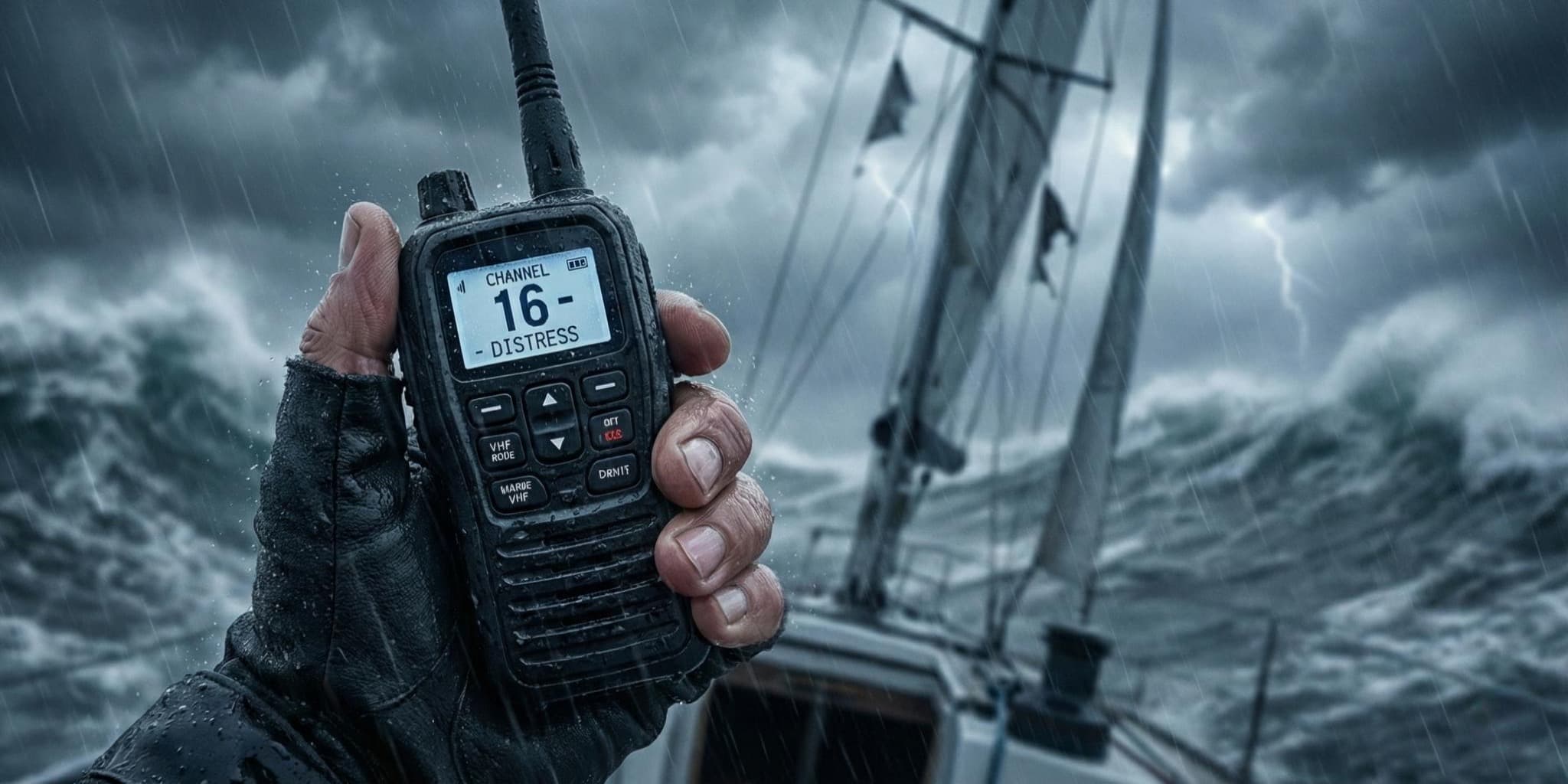
2026 Guide to VHF Radio: Mastering Marine Comms and the Mayday Call
Introduction: The Lifeline in Your Hand
Imagine the serene blue of the Mediterranean or the rugged coastline of the Pacific suddenly turning into a scene of urgency. A fire in the galley, a sudden hull breach, or a medical crisis—these are the moments where "adventure" meets "reality." In the middle of the ocean, your cell phone is often a decorative brick. Your only true connection to the world and professional rescue services is the VHF (Very High Frequency) Radio .
As we move through 2026, maritime technology has become more integrated with Digital Selective Calling (DSC) and satellite tracking, yet the core of emergency communication remains the human voice. Knowing how to use your VHF correctly is not just a skill—it is a responsibility. This guide will walk you through the essential protocols of marine communication and, most importantly, provide you with the exact, step-by-step procedure to make a Mayday call when seconds count.
1. VHF Radio Etiquette: The Rules of the Airwaves
Before you can call for help, you must understand how to coexist on the shared frequencies of the maritime community. The VHF radio is a public forum; every transmission is heard by every boat and coast station within range.
- Listen Before You Speak: Always monitor the channel for a few seconds before pressing the Push-to-Talk (PTT) button to ensure you aren't "stepping" on another transmission.
- The One-Minute Rule: Channel 16 is for distress, safety, and initial calling only. Once contact is made, immediately switch to a "Working Channel" (like 68, 69, or 72) to keep the emergency line clear.
- Plain Language: Avoid "CB talk" or complex codes. Use clear, concise English and the International Phonetic Alphabet (Alpha, Bravo, Charlie) to spell out names or locations.
- Low Power for Close Range: If the boat you are calling is within a few miles, use the 1W (Low Power) setting to reduce signal "clutter" for distant stations.
2. Emergency Phrases: Mayday, Pan-Pan, and Securite
In 2026, the global standard for emergency calls remains categorized by the level of "Grave and Imminent Danger."
- MAYDAY: Used only when there is an immediate threat to life or the vessel (sinking, fire, man overboard). It grants you absolute priority over all other radio traffic.
- PAN-PAN: Used for urgent situations that are not yet life-threatening (mechanical failure in a shipping lane, a controllable leak, or a non-critical medical issue).
- SECURITE: Used to broadcast safety information, such as weather warnings or navigational hazards (a floating log or a lighthouse that is out of service).
3. How to Make a Mayday Call: The 2026 Protocol
If you find yourself in a life-threatening situation, stay calm. Follow this exact script. If your radio is equipped with DSC (Digital Selective Calling) , press the red "Distress" button for five seconds before making the voice call; this sends your GPS coordinates automatically.
The Mayday Script (MIPDANIO Format)
- Select Channel 16 and set to High Power (25W).
- The Call: "MAYDAY, MAYDAY, MAYDAY."
- Identification: "This is [Vessel Name] [Vessel Name] [Vessel Name]. Callsign [State your callsign]."
- Position: "MAYDAY [Vessel Name]. My position is [Latitude/Longitude or Bearing and Distance from a Landmark]."
- Distress: "The nature of my distress is [Fire / Sinking / Grounding / etc.]."
- Assistance: "I require immediate assistance."
- Number of People: "There are [Number] people on board."
- Information (Extra): "We are a [Length/Color/Type of Boat]. We are abandoning ship to the life raft."
- Over: "This is [Vessel Name]. OVER ."
4. VHF Channel Quick-Reference Table
| Channel | Primary Use | Mode | 2026 Usage Tip |
|---|---|---|---|
| 16 | Distress, Safety, & Calling | Simplex | Monitor this at all times while underway. |
| 70 | DSC Only (Digital) | Digital | Zero voice allowed. Used for auto-distress alerts. |
| 09 | Secondary Calling | Simplex | Use this to hail friends to keep Ch 16 clear. |
| 13 | Bridge-to-Bridge | Simplex | Use (1W) to talk to commercial ships near you. |
| 22A | Coast Guard Liaison | Simplex | Used for extended comms with the Coast Guard. |
| 68, 69, 72 | Working Channels | Simplex | For non-commercial "ship-to-ship" chat. |
5. The 2026 Essential VHF Checklist
- [ ] Radio Check: Perform a radio check on a working channel (not 16!) before every departure.
- [ ] Laminated Guide: Keep a laminated copy of the Mayday script (like the one above) next to your radio station.
- [ ] Battery Status: If using a handheld VHF, ensure it is fully charged or carries fresh spare batteries.
- [ ] GPS Integration: Ensure your fixed VHF is connected to your GPS so the DSC button sends your exact location.
Conclusion: Ready for Any Horizon
Mastering the VHF radio is a hallmark of a professional mariner. It is the bridge between isolation and assistance. By understanding these protocols and practicing the Mayday script, you ensure that even in the most challenging moments, you remain in command. In 2026, the sea is more connected than ever, but it still rewards the prepared.
Would you like me to help you find an SRC (Short Range Certificate) course near you or suggest the best waterproof handheld VHF models for your 2026 charter?
FAQ Section
Q: What do I do if I hear a Mayday call and no one answers?
A: If you hear a distress call and it is not acknowledged by a Coast Guard station after two minutes, you must answer and attempt to "Relay" the message to the authorities. Use the phrase "MAYDAY RELAY" and provide the details of the vessel in distress.
Q: Can I use my VHF on land?
A: No. It is illegal to use a marine VHF radio on land without a specific "Shore Station" license. Using it away from the water can interfere with critical maritime safety communications and can result in heavy fines.
Q: What is the range of a typical VHF radio?
A: VHF is "line-of-sight." A handheld unit usually reaches 3–5 miles, while a fixed unit with a masthead antenna can reach 15–25 miles. In 2026, many coastal areas have "repeater" stations that can extend this range significantly.
Meta Title: VHF Radio Usage & How to Make a Mayday Call 2026 Guide
Meta Description: Learn essential 2026 VHF radio protocols and the exact step-by-step script for making a maritime Mayday call. Stay safe with our expert guide to marine comms.
Tags: VHF Radio, Mayday Call, Maritime Safety, Marine Communication, Yacht Charter 2026, DSC Radio, Sailing Tips, Coast Guard
Category: Safety & Navigation
Tags:
Related Articles
Safe Horizons: A Master Guide to Child Safety on Board for 2026
Protect your youngest explorers. Master the 2026 essentials of yacht safety netting, lifejacket tech, and deck rules for a worry-free family voyage.
Deciphering the Deep: A 2026 Guide to Understanding Symbols on Nautical Charts
Unlocking the secrets of the sea floor. Master the vital language of nautical chart symbols to ensure a safe and professional voyage in 2026.
Standing Firm: Deck Safety in Rough Seas Using Jacklines 2026 Guide
Stay tethered to life. Discover the professional 2026 protocols for using jacklines and harnesses to survive the fury of the open sea.